Blog /
SPY fell 5.1% in four days, and the rules rolled UPRO and JNJ
SPY fell 5.1% from Monday to Thursday, and the example campaigns gave back $2,376. On Thursday the rules called for two trades. UPRO's long call had slipped to 0.66 delta, so the rules re-centred it and rolled the weekly call a day early. JNJ's short call rolled at 74% of its credit. IWM closed below the put's strike, and the rules hold it. A fourth campaign, a wheel on KO, sold its first put.
By Team Iron Wheel
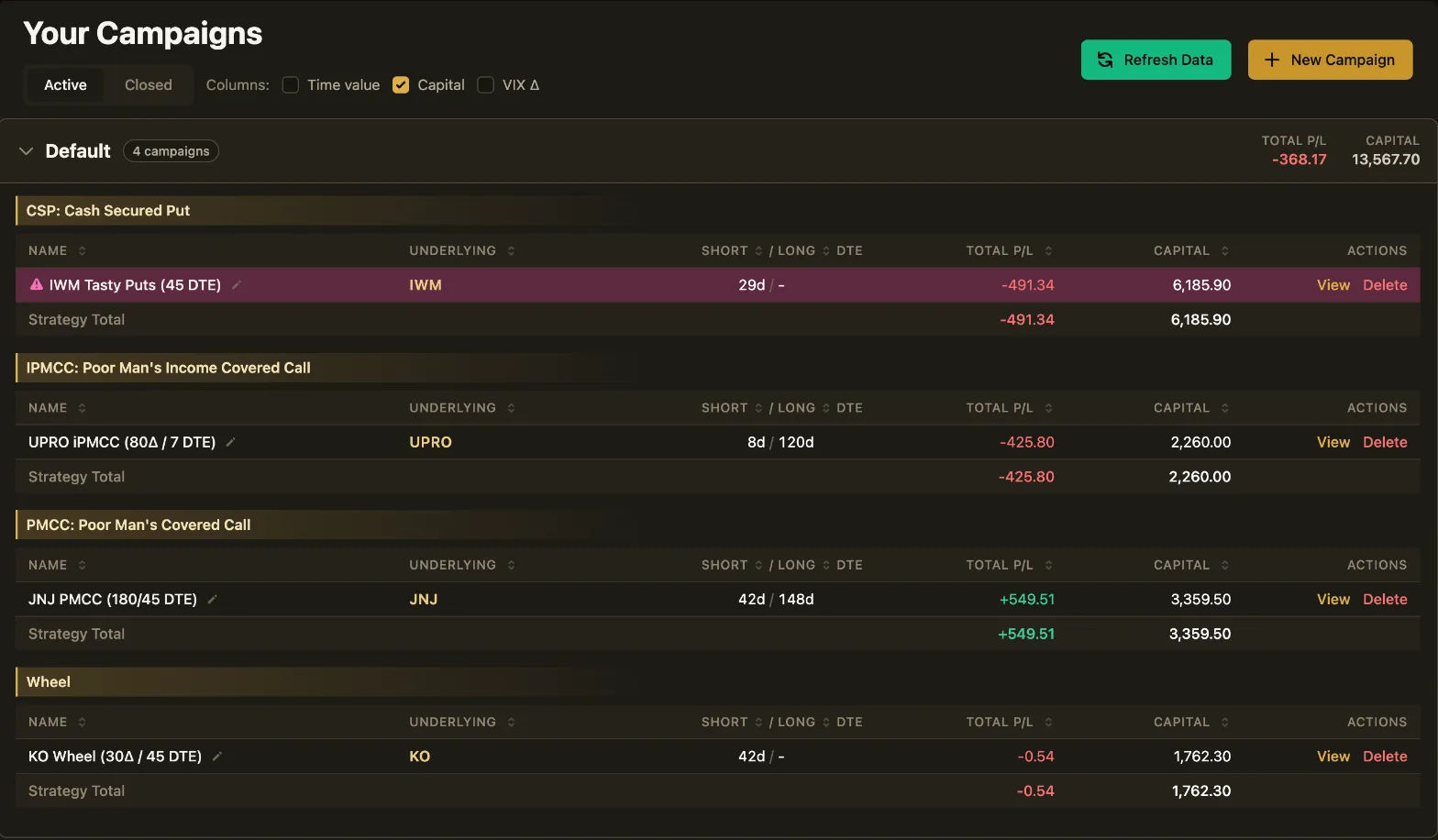
The sell-off ran four days, and SPY fell 5.1%. The example campaigns gave back $2,376 from Friday's close and are now $368.17 down. On Thursday the rules called for two trades. UPRO's long call had slipped to 0.66 delta, so the rules re-centred it and rolled the weekly call with it. JNJ's short call passed its profit target. IWM closed below the put's strike, and the rules hold it. A fourth campaign opened too, a wheel on KO. The figures are from The Iron Wheel at Thursday's close, November 19. It is an example for education, not a recommendation.
| Campaign | P/L | Since November 13 | Thursday | Next trigger |
|---|---|---|---|---|
| UPRO iPMCC | −$425.80 | −$652.62 | Rolled and re-centred | Weekly expiration on November 27 |
| JNJ PMCC | +$549.51 | −$1,151.60 | Short call rolled | 21 days to expiration on December 10 |
| IWM puts | −$491.34 | −$571.00 | Held | 21 days to expiration on November 27 |
| KO wheel | −$0.54 | −$0.54 | First put sold | 21 days to expiration on December 10 |
| All four | −$368.17 | −$2,375.76 |
The market: four red days
SPY fell on all four days, and Thursday hurt most. It opened 1% higher, then closed 2% lower, at its lowest since April 29.
| Thursday, November 19 | Close | Thursday | Since Friday |
|---|---|---|---|
| SPY | $715.87 | −2.0% | −5.1% |
| QQQ | $645.04 | −2.2% | −5.1% |
| IWM | $264.22 | −2.2% | −4.8% |
| UPRO | $117.89 | −6.0% | −14.9% |
| JNJ | $267.14 | −2.0% | −6.5% |
| KO | $96.09 | −2.0% | −3.2% |
| VIX | 28.44 | +15.8% | +47.4% |
VIX rose by almost half over the four days. CNN's Fear & Greed index for stocks fell from 39 on Friday to 19, extreme fear.
Since Tuesday's review, the three older campaigns lost another $1,317.22.
UPRO: a roll and a re-centre

UPRO fell 14.9% in four days, to $117.89, its lowest close since April. Thursday alone took 6.0%. Thursday's trades closed both legs of the pair that went on at Friday's roll.
- The short 133 call: sold for $6.90, bought back for $0.10, a gain of $677.90.
- The long 110 call: bought for $34.40, sold for $21.06, a loss of $1,335.31.
The short call gave up nearly all of its price. The rest of the fall landed on the long call.
A day early
The rules roll the short call on Fridays. This one went a day early, because the long call was due a re-centre and the roll went in at the same sitting. The expiring call had $0.10 left, above the $0.05 that brings a roll forward on its own.
Thursday's schedule also kept the trades out of the session's last 30 minutes. All of them went in between 3:14 and 3:20 pm ET.
The roll
| Order | Price | Commission | Net |
|---|---|---|---|
| Buy 1 UPRO Nov 20 2026 133 call | $0.10 | $1.05 | $11.05 debit |
| Sell 1 UPRO Nov 27 2026 113 call | $9.30 | $1.07 | $928.93 credit |
Net credit: $917.88.
The strike moved down with UPRO, from 133 to 113. The new call runs 8 days, to the Friday after Thanksgiving, at about 0.69 delta by a Black-Scholes estimate. With UPRO at about $119, it was about $6 in the money. The other $3.29 of its price is time value, the part next week is meant to earn.
The long call moves down
A minute later, the long call moved down to the 95 strike.
| Order | Price | Commission | Net |
|---|---|---|---|
| Sell 1 UPRO Mar 19 2027 110 call | $21.06 | $0.27 | $2,105.73 credit |
| Buy 1 UPRO Mar 19 2027 95 call | $31.61 | $0.23 | $3,161.23 debit |
Net debit: $1,055.50.
The app had the 110 call at 0.66 delta at Thursday's close, well below its 77–82 band. The rules swap it for a new 80-delta call, and the 95 call closed at 0.78. The lower strike costs more. Together, the roll and the re-centre cost $137.62.
The two trades booked the old pair's result, and the campaign's realized P/L went from +$203.91 to −$453.50.
At Thursday's closing prices, the old pair moved like 63 shares of UPRO. The new one moves like 12, close to the 14 it started with.
Where UPRO stands
The best case and the unchanged case come from the app's P/L profile, which prices the long call at Thursday's implied volatility, so they're estimates. Both count the $453.50 already lost.
- Best case next week: about +$32, with UPRO at $113 on November 27. The short call expires worthless there, and the long call keeps its time value.
- UPRO unchanged at $117.89: about −$82. The short call still holds $4.89 of intrinsic value, and the long call loses a week of time value.
- Max loss: $2,685.80, with UPRO below $95 when the long call expires in March. It leaves out the weekly rolls still to come.
Max loss = open debit + realized loss = $2,232.30 + $453.50 = $2,685.80
JNJ: the short call hit its target

JNJ set a one-year high of $290.25 on Monday. By Thursday's close it had fallen 8.0% from there, to $267.14.
The fall worked for the short call. The rules buy it back below about $1.53, half its $3.05 credit. On Thursday they bought the 295 call back for $0.78, keeping 74% of the credit.
The roll
| Order | Price | Commission | Net |
|---|---|---|---|
| Buy 1 JNJ Dec 24 2026 295 call | $0.78 | $0.55 | $78.55 debit |
| Sell 1 JNJ Dec 31 2026 285 call | $2.58 | $0.55 | $257.45 credit |
Net credit: $178.90.
The buy-back banked $225.90. The new call's strike moved down with JNJ, from 295 to 285. It's 42 days out, the expiration nearest 45. The app put it at 0.24 delta at the close.
The long call stays
The rules replace the long call on any of three triggers. None applies.
- Under 0.70 delta. It closed at 0.76.
- Under 90 days. It has 148 left.
- A short call rolled for a debit. This roll paid a $178.90 credit.
Where JNJ stands
The campaign gave back $1,151.60 from Friday's close. It's still $549.51 up, with $1,323.11 of that banked.
By the P/L profile's estimate, the campaign does best with JNJ at $285 on December 31, about $2,047 up. Its break-even, counting what's banked, is about $259, 3.1% below Thursday's close.
IWM: below the strike
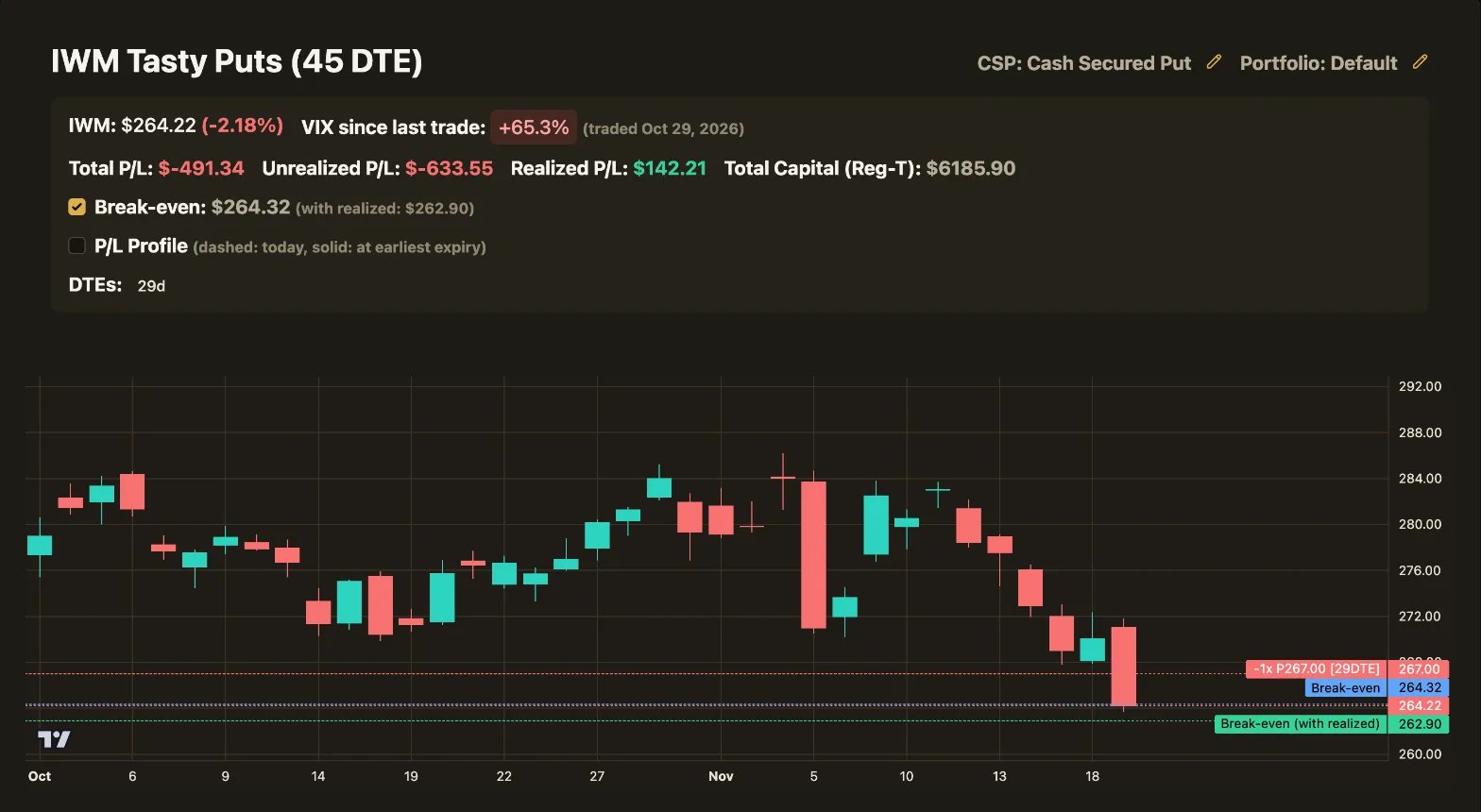
IWM fell 4.8% in four days, to $264.22. On Thursday it closed below the put's strike for the first time, at its lowest close since April. On Tuesday it had stopped 87 cents short.
The put is $2.78 in the money. It's at $9.02, against the $2.69 it sold for, and $633.55 under water. The campaign is $491.34 down.
The put's delta is 0.53, so the position moves like 53 shares of IWM. It ties up $6,185.90 of capital.
The rules still hold
The rules have no stop-loss, and a strike crossed isn't an exit either. They buy the put back below about $1.35, half its credit. Otherwise they close or roll it at 21 days, on Friday, November 27.
An early assignment is unlikely while the put holds $6.24 of time value. The put stays open.
The plan
- Friday, November 27: UPRO. The 113 call rolls to the next week's 70-delta call. It's the day after Thanksgiving. The market closes at 1 pm ET that day, so the last 30 minutes start at 12:30. If the long call's delta leaves 77–82, the rules swap it for a new 80-delta call.
- Friday, November 27: IWM. Unless it trades below about $1.35 first, the put reaches 21 days, and the rules close or roll it.
- JNJ. Once the 285 call trades below about $1.29, the buy-back goes in during a session's last 30 minutes. Otherwise it rolls at 21 days, on Thursday, December 10.
- KO. Its first post sets out the plan for the put.
- Next week. The Week 6 review covers all four campaigns.