Blog /
A wheel on KO: the first put
The wheel sells puts until a stock is assigned, then sells covered calls on the shares. This fourth example campaign runs one on KO, Coca-Cola's stock. The rules, and the first put, sold for $1.50 with a break-even 4.8% below KO's close.
By Team Iron Wheel
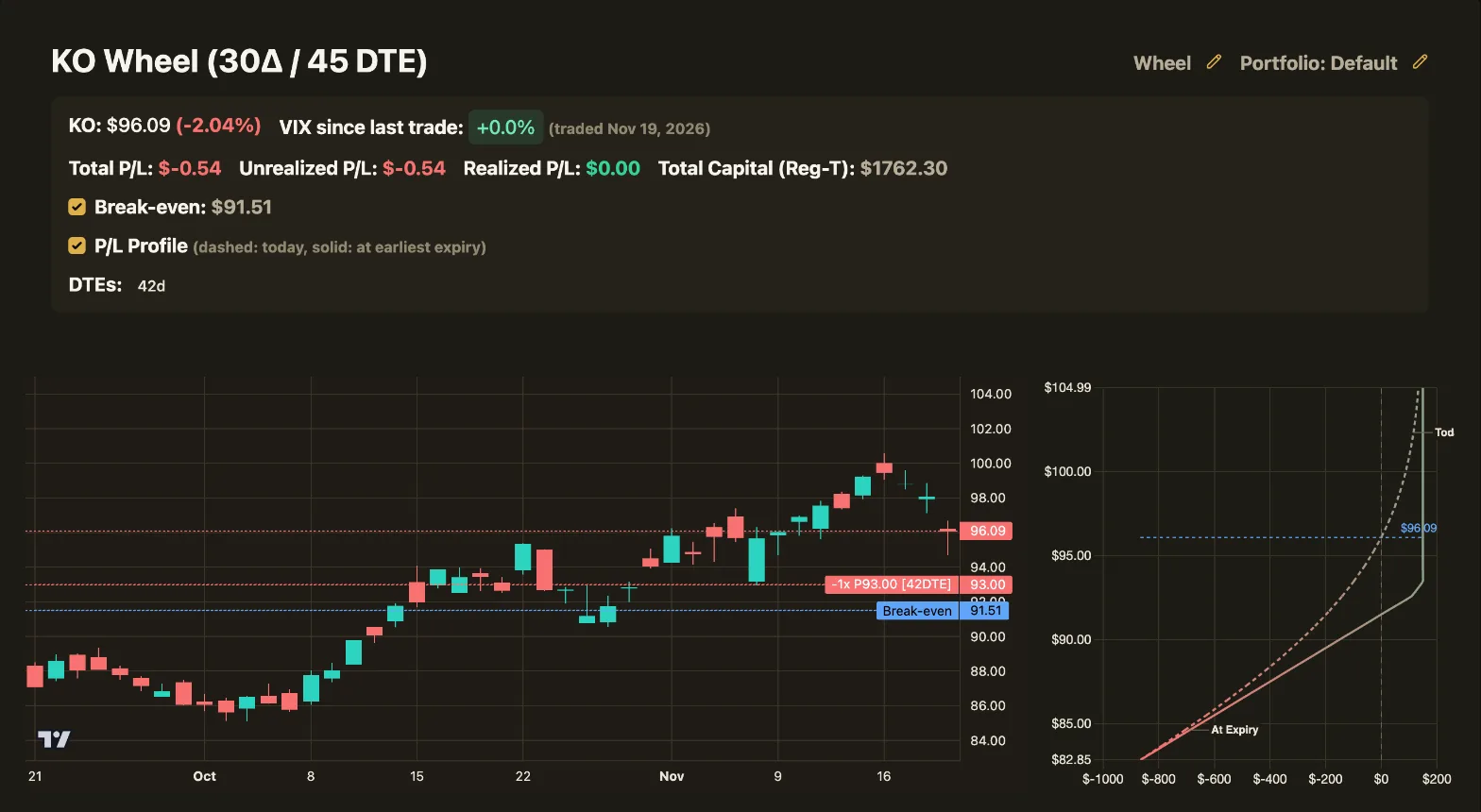
The wheel sells puts on a stock until one is assigned, then sells covered calls on the shares until they're called away. This fourth example campaign runs a wheel on KO, Coca-Cola's stock. The first put sold on Thursday afternoon, November 19. The figures are from The Iron Wheel at that day's close. It is an example for education, not a recommendation.
| At a glance | |
|---|---|
| Strategy | Short 30-delta put, 45 days out; covered calls once assigned |
| Directional assumption | Neutral to bullish |
| Ideal implied volatility | High, then falling |
| Max profit | $148.96, with KO at or above $93 on December 31 |
| Max loss | $9,151.04, if KO went to zero |
| Break-even | $91.51 on December 31 |
| Capital | $9,300 to buy the shares; $1,762.30 under Reg-T margin |
What the wheel is
The wheel starts as a cash-secured put. The seller collects a premium and agrees to buy 100 shares at the strike if the put is assigned. The IWM campaign sells puts the same way, but it closes them before they can be assigned. The wheel takes the shares.
Once it owns them, it sells covered calls, for a premium each time, against a promise to sell the shares at the call's strike. If a call is assigned, the shares go, and the wheel starts again with puts.
| IWM puts | KO wheel | |
|---|---|---|
| Put sold | 20 delta, 45 days | 30 delta, 45 days |
| Profit target | Half the credit | Half the credit |
| At 21 days | Close or roll | Close or roll if in profit, otherwise hold |
| Assignment | Avoided | Accepted |
| After assignment | None planned | Covered calls, 20–25 delta, 45 days |
The rules
| Leg | Open | Close or roll |
|---|---|---|
| Put | Sell at about 30 delta, about 45 days out | At half the credit, or at 21 days if in profit; otherwise held to expiration |
| Covered call | Sell at 20–25 delta, about 45 days out, never below break-even | As the put |
- 30 delta. A 30-delta put has about a three-in-ten chance of finishing in the money. It sits closer to the price than IWM's 20-delta put and collects more for it. That suits a campaign that's willing to own the shares.
- 45 days, half the credit, 21 days. These are the IWM campaign's mechanics. The second half of a premium is the slowest to arrive, and the last three weeks carry the most risk from a sharp move.
- A losing put rides to expiration. At 21 days the rules don't close a put at a loss. If KO is below $93 on December 31, the put is assigned and the campaign owns 100 shares at $93.
- No call below break-even. The break-even is what the shares cost, less the premium collected. A call struck below it could sell the shares at a loss.
- Banked cash buys more KO. Premium the campaign realizes goes into more KO shares, so the cash keeps working.
The trade
The put sold at 3:14 pm ET on Thursday, with KO near $96.
| Detail | Value |
|---|---|
| Order | Sell 1 KO Dec 31 2026 93 put |
| Days to expiration | 42, the expiration nearest 45 |
| Premium | $1.50 a share, $150 for the contract |
| Commission | $1.04 |
| Net credit | $148.96 |
| Delta | 0.31 |
The strike sits about 3% below KO. All of the $1.50 is time value, since the put is out of the money. Time decay works for the seller.
Max profit, max loss and break-even
- Max profit: $148.96, the whole credit, if KO is at or above $93 on December 31. It comes to 1.6% of the $9,300 the shares would cost, in 42 days.
- Break-even: $91.51 on December 31, 4.8% below Thursday's close. Between $93 and $91.51, the put is assigned and the campaign still comes out ahead.
- Max loss: $9,151.04, if KO went to zero. Below the break-even, the put loses a dollar for each dollar KO falls.
Break-even = strike − credit a share = $93 − $1.49 = $91.51
Max loss = break-even × 100 shares = $91.51 × 100 = $9,151.04
Capital
Taking the shares means paying $9,300 for them. While the put is open, a margin account holds less. The app puts the Reg-T requirement at $1,762.30 at Thursday's close. The put can lose just as much either way. P/L, capital and break-even explains how the requirement is worked out.
Where it stands

KO closed Thursday at $96.09, a few cents below the fill. The put closed at $1.50, where it sold, so the campaign is down 54 cents after commission. With a delta of 0.31, the put moves like 31 shares of KO.
No rule applies yet. The profit target is a long way off, and 21 days is three weeks away.
The plan
- Profit target. Once the put trades below about $0.75, half its credit, the buy-back goes in during a session's last 30 minutes. The next 30-delta put sells at the same time.
- Thursday, December 10. The put reaches 21 days. If it's in profit, the rules close it or roll it to the next 45-day put. If it isn't, they hold it.
- Thursday, December 31. Below $93, the put is assigned, and the campaign buys 100 shares at $93. Then it sells covered calls, never below the $91.51 break-even.
- Next week. The weekly review covers all four example campaigns.
Summed up
- The wheel sells puts until a stock is assigned, then sells covered calls on the shares.
- Unlike the IWM puts, a losing KO put is held to expiration and the shares are taken.
- The first put collected $148.96, with a break-even at $91.51.
- Owning the shares would cost $9,300, so the best case is 1.6% in 42 days.
- Below $91.51, the put loses a dollar for each dollar KO falls.