Blog /
Week 5 review: SPY fell 2.9%, and the campaigns gave back $1,058
SPY fell 2.9% on Monday and Tuesday, and the three example campaigns gave back $1,058 without a trade, more than all of last week's gain. They're still $949.59 up. UPRO fell 8.6%, more than its short call could cushion, and IWM came within 87 cents of the put's strike. The rules hold JNJ and the IWM put. Friday brings UPRO's weekly roll and a re-centre of its long call.
By Team Iron Wheel
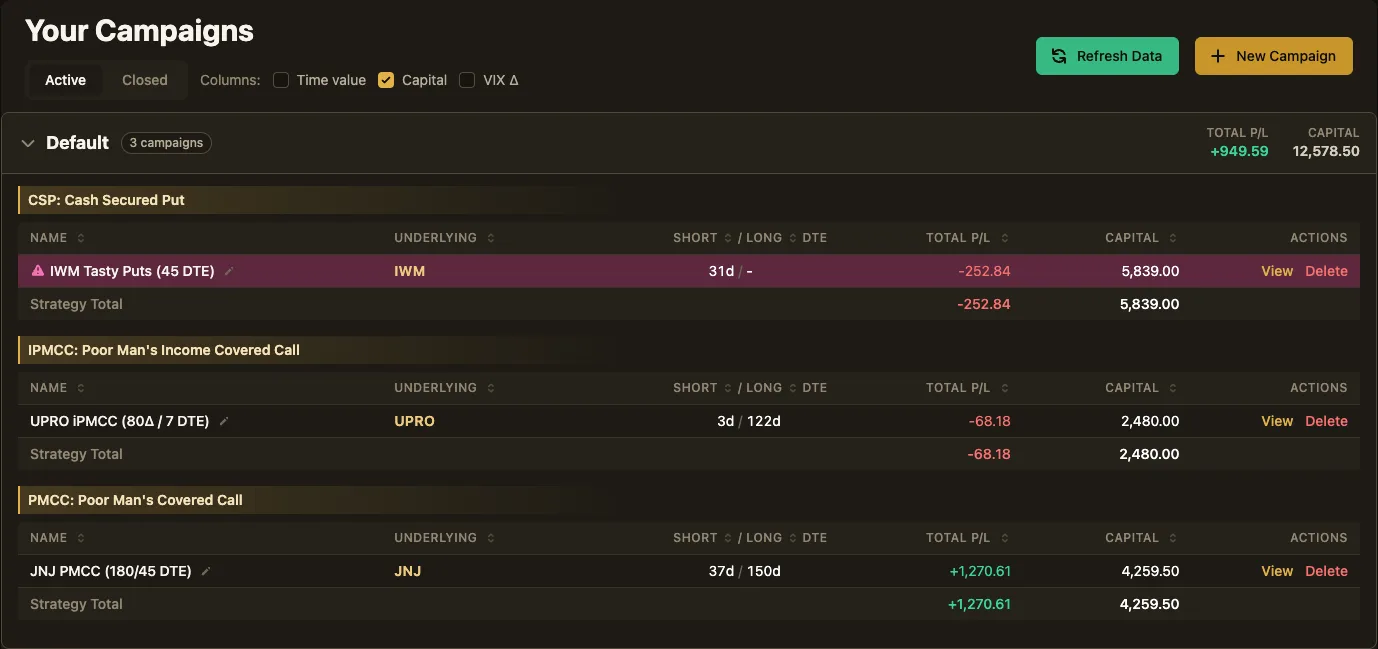
Two red days took back more than all of last week's gain. SPY fell 2.9% on Monday and Tuesday, and the three example campaigns gave back $1,058 without a trade. They're still $949.59 up. UPRO fell 8.6%, more than its short call could cushion, and its long call slipped out of its delta band. IWM came within 87 cents of the put's strike. The rules hold JNJ and the IWM put, and Friday brings UPRO's roll and a re-centre. The figures are from The Iron Wheel at Tuesday's close, November 17. It is an example for education, not a recommendation.
| Campaign | P/L | Since Friday | Nearest rule trigger | Action |
|---|---|---|---|---|
| UPRO iPMCC | −$68.18 | −$295.00 | Long call at 0.73 delta, band 77–82 | Roll and re-centre on Friday |
| JNJ PMCC | +$1,270.61 | −$430.50 | 21 days to expiration on December 3 | Hold |
| IWM puts | −$252.84 | −$332.50 | 21 days to expiration on November 27 | Hold |
| All three | +$949.59 | −$1,058.00 |
The market: two red days
Monday did most of the damage. SPY fell 1.9% that day and another 1.0% on Tuesday. It closed at its lowest since July 29.
| Ticker | Tuesday's close | Monday | Tuesday | Since Friday |
|---|---|---|---|---|
| SPY | $732.44 | −1.9% | −1.0% | −2.9% |
| QQQ | $656.95 | −2.7% | −0.7% | −3.4% |
| IWM | $269.05 | −1.7% | −1.4% | −3.1% |
| UPRO | $126.54 | −5.6% | −3.2% | −8.6% |
| JNJ | $278.70 | −1.1% | −1.4% | −2.5% |
| VIX | 25.46 | +18.7% | +11.1% | +31.9% |
VIX rose by almost a third. CNN's Fear & Greed index for stocks fell from 39 on Friday to 25, extreme fear.
All three campaigns gain when prices rise, and UPRO aims for three times the S&P 500's daily move. A broad drop hits all three at once.
UPRO: more than the short call could cushion

UPRO fell 8.6% in two days, to $126.54. Since Friday's roll, the long 110 call has lost $851.04. The short 133 call has made $578.95 of it back.
A short call can only give back what it was sold for. The 133 call sold for $6.90, and UPRO has fallen about $11.45 since. At $1.10, the call has little left to give.
As UPRO fell, the short call's delta shrank faster than the long call's. The pair now moves like 50 shares of UPRO.
Where UPRO stands
If UPRO is still at $126.54 on Friday, the campaign comes out about flat, by the P/L profile's estimate. Its break-even, counting the $203.91 already banked, is about $126, just below Tuesday's close. Back at $133, the campaign would be up about $515.
The rules: roll, and re-centre
- The short call rolls on Friday. Its $1.10 is all time value, well above the $0.05 that brings the roll forward. The roll takes it from 0.23 delta back to about 0.70.
- The long call is due a re-centre. At 0.73 delta it's below its 77–82 band. The rules sell it and buy a new 80-delta call at a lower strike, which costs more.
The rules don't set a day for the re-centre. The last three went in with the Friday roll, and this one is planned the same way.
JNJ: another high, then two red days
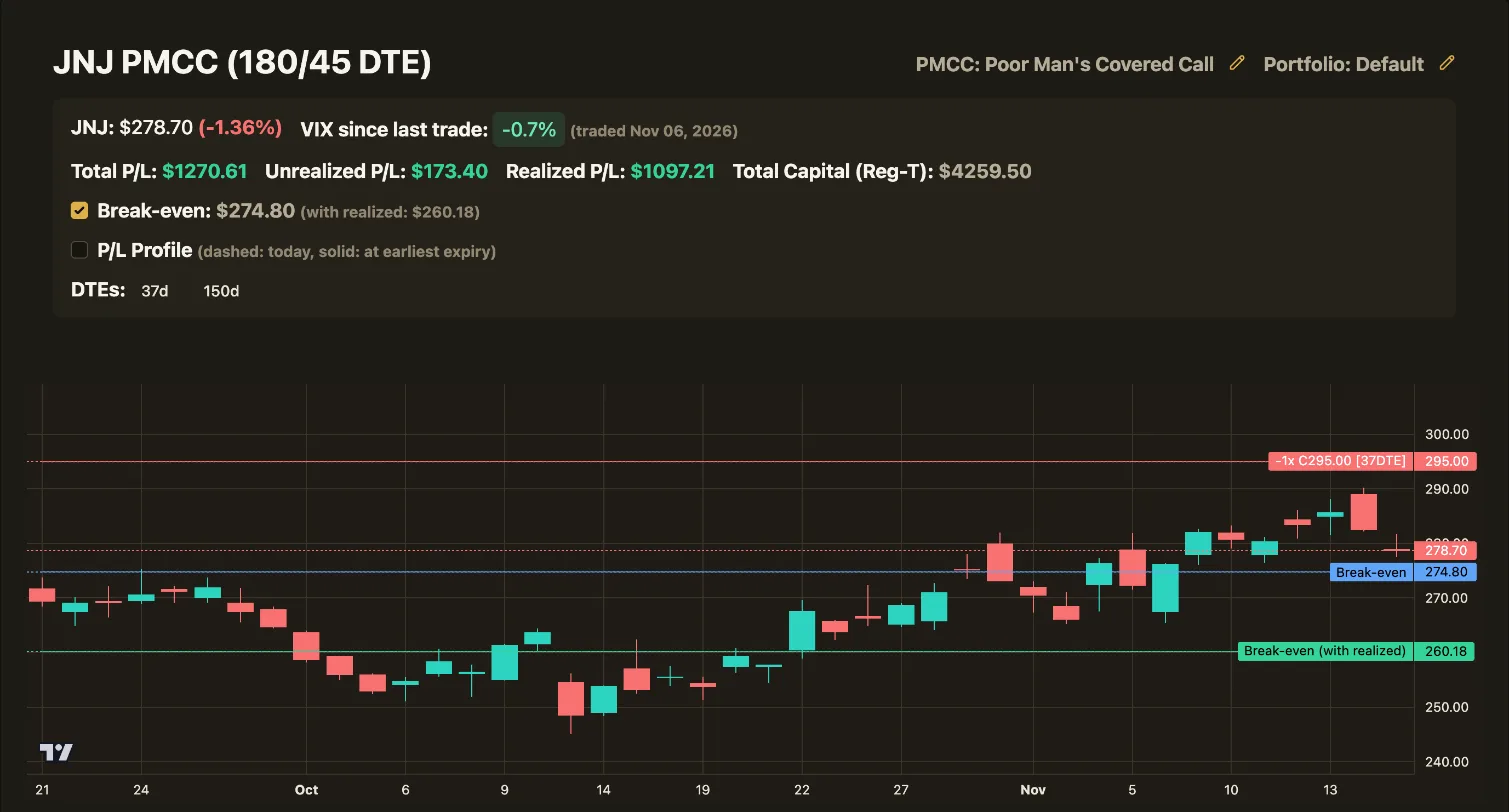
JNJ set another one-year high on Monday, at $290.25, then fell for two days. It closed Tuesday at $278.70, down 2.5% from Friday.
The campaign gave back $430.50. The long call lost $630.00, and the short call made back $199.50. The campaign is still $1,270.61 up, with $1,097.21 of it banked.
The rules hold
No rule applies yet.
- The short call is at $3.43, a long way from the buy-back at about $1.53, half its credit. It reaches 21 days on Thursday, December 3.
- The long call sits at 0.82 delta, above the 0.70 floor. It has 150 days left, and the rules roll it under 90.
IWM: 87 cents from the strike
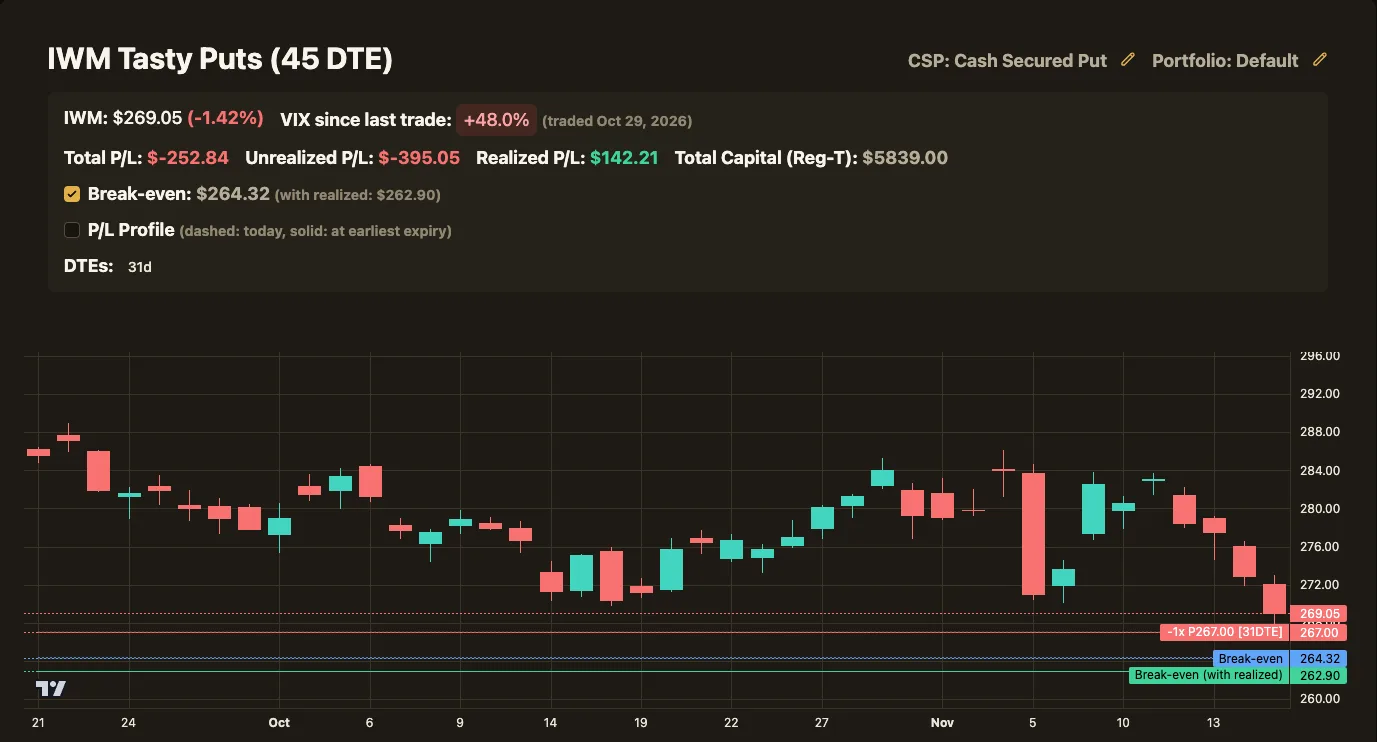
IWM fell 3.1% in two days, to $269.05, its lowest close since April. Tuesday's low of $267.87 came within 87 cents of the put's strike. Two weeks ago, the closest it got was $3.23.
The put doubled, from $3.31 to $6.63. Its open loss grew from $62.55 to $395.05. The campaign is $252.84 down. The put's delta rose to 0.43, and the capital it ties up to $5,839.00.
Why the put doubled
By a Black-Scholes estimate, the put's $3.32 rise splits three ways.
- IWM's fall added about $2.96.
- Implied volatility added about 77 cents. IWM's rose from about 23% to 25%.
- Four days of time decay took off about 40 cents.
VIX jumped by almost a third, but IWM's own implied volatility moved much less. IWM's price did most of the work, as it did in the other direction last week.
The rules still hold
This is the moment fixed exits are for. The put is $395.05 under water, with IWM just above the strike, and the rules have no stop-loss.
They buy the put back below about $1.35, half its credit. Otherwise they close or roll it at 21 days, on Friday, November 27. The put stays open.
The plan
- Friday, November 20: UPRO. The 133 call rolls to next week's 70-delta call in the session's last 30 minutes, or sooner if its time value drops below $0.05. If the long call's delta is still outside 77–82, the rules re-centre it with the roll.
- JNJ. Once the short call trades below about $1.53, the buy-back goes in during a session's last 30 minutes. Otherwise it rolls at 21 days, on Thursday, December 3.
- IWM. Below about $1.35, the buy-back goes in during a session's last 30 minutes. Otherwise the put reaches 21 days on Friday, November 27, the day after Thanksgiving. The market closes at 1 pm ET that day, so the last 30 minutes start at 12:30.
The next review follows in a week.