Blog /
SPY fell 4.4% in a day, and the campaigns gave back $87
SPY fell 4.4% on Thursday, November 5, and UPRO 13%. From the Week 3 review to Friday's close, the three example campaigns gave back $87. On Friday UPRO's weekly call rolled and its long call moved down. JNJ's short call rolled for a debit, so its long call rolled up too, and the two JNJ rolls took in $632.68. The IWM put held.
By Team Iron Wheel
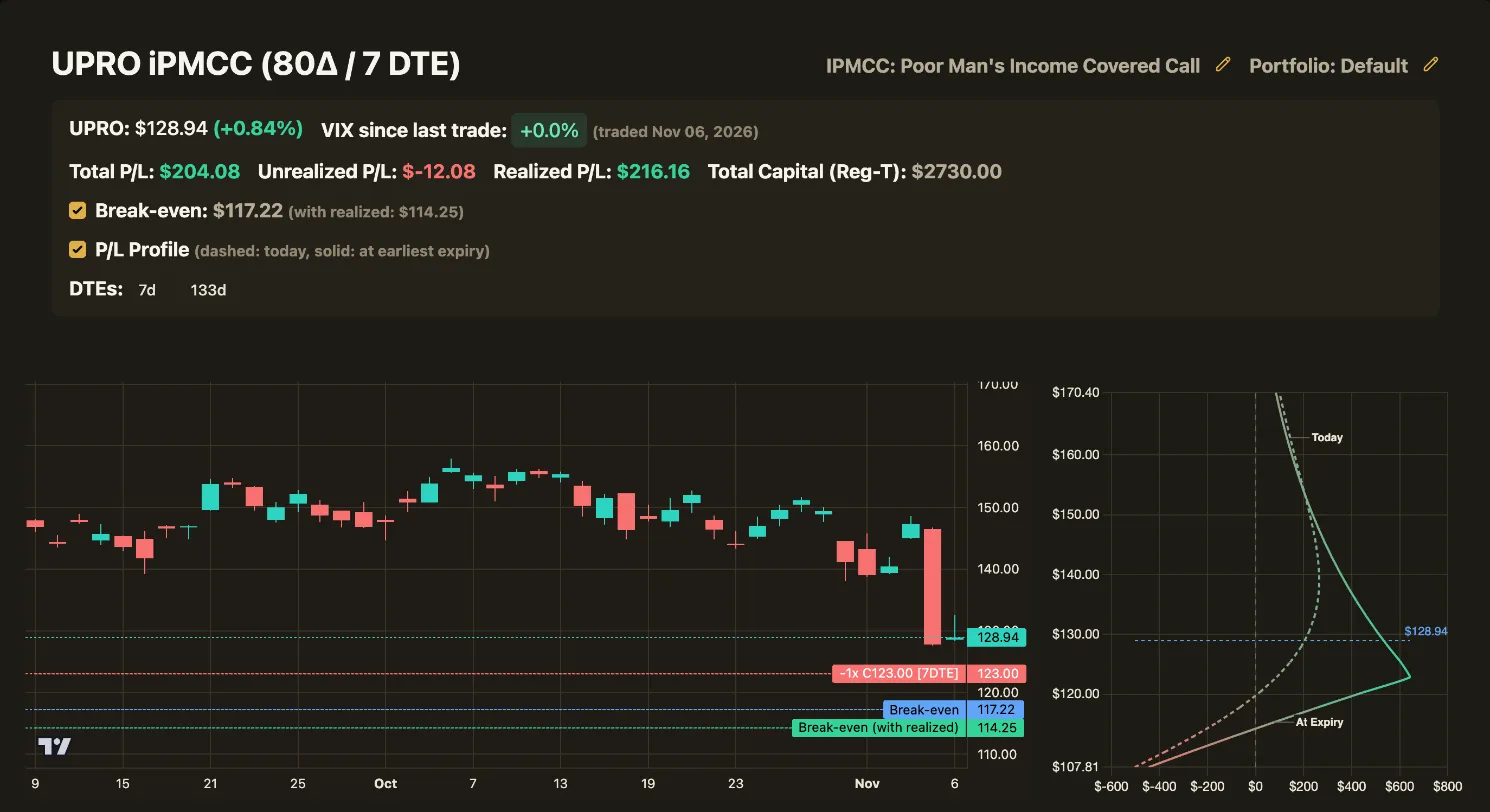
SPY fell 4.4% on Thursday, and VIX jumped 70%. From the Week 3 review to Friday's close, the three example campaigns gave back $87. Friday was roll day for two of them. UPRO's weekly call rolled, and its long call moved down. JNJ's short call rolled for a debit. Under the rules that takes the long call with it, and the two rolls together took in $632.68. The IWM put came close to its strike, and the rules hold it. The figures are from The Iron Wheel at Friday's close, November 6. It is an example for education, not a recommendation.
| Campaign | P/L | Since Week 3 | Friday | Next trigger |
|---|---|---|---|---|
| UPRO iPMCC | +$204.08 | −$104.21 | Rolled, long call moved down | Weekly expiration on November 13 |
| JNJ PMCC | +$1,028.61 | +$207.68 | Both calls rolled | 21 days to expiration on December 3 |
| IWM puts | −$181.34 | −$190.50 | Held | 21 days to expiration on November 27 |
| All three | +$1,051.35 | −$87.03 |
The market: Thursday's drop
Wednesday had been a good day. SPY rose 1.7%, and VIX closed at 16.61. Then Thursday gave SPY its worst day since the campaigns began in October.
| Thursday, November 5 | Close | Change |
|---|---|---|
| SPY | $733.00 | −4.4% |
| QQQ | $647.05 | −6.5% |
| IWM | $270.98 | −4.6% |
| UPRO | $127.87 | −13.2% |
| JNJ | $272.32 | −1.4% |
| VIX | 28.18 | +70% |
CNN's Fear & Greed index for stocks closed Thursday at 20, in extreme fear. Friday steadied. SPY gained 0.3%, and VIX eased to 25.64. Since the Week 3 review, SPY is down 2.5%.
UPRO: the short call absorbed the fall
UPRO fell 7.4% from one roll to the next, to about $129.60. The pair made $20.59 over the same week.
- The short 134 call: sold for $8.28, bought back for $0.06. It kept 99% of its price, a gain of $820.71.
- The long 110 call: bought for $37.19, sold for $29.21, a loss of $800.12.
- 100 shares of UPRO would have lost about $1,040 over the same move.
About $6 of the short call's price was in the money at the sale. UPRO's fall drained that $6 out of the call, along with its time value, and the pair kept it. The long call, at about 0.8 delta, lost close to what the short call made.
The roll
By 1:30 pm ET on Friday, the expiring 134 call was down to 6 cents, a cent above the $0.05 that brings the roll forward. Both campaigns rolled then.
| Order | Price | Commission | Net |
|---|---|---|---|
| Buy 1 UPRO Nov 6 2026 134 call | $0.06 | $1.04 | $7.04 debit |
| Sell 1 UPRO Nov 13 2026 123 call | $9.50 | $0.05 | $949.95 credit |
Net credit: $942.91.
The strike moved down with UPRO, from 134 to 123. The new call is 7 days out at about 0.70 delta, by a Black-Scholes estimate. With UPRO at about $129.60, it was about $6.60 in the money. The other $2.90 of its price is time value, and that's what next week sells.
The long call moves down
Two minutes later, the long call moved down to the 100 strike.
| Order | Price | Commission | Net |
|---|---|---|---|
| Sell 1 UPRO Mar 19 2027 110 call | $29.21 | $1.09 | $2,919.91 credit |
| Buy 1 UPRO Mar 19 2027 100 call | $36.91 | $1.03 | $3,692.03 debit |
Net debit: $772.12.
Thursday's drop pulled the 110 call below its 77–82 delta band, to 0.74 by Friday's close. The rules swap it for a new 80-delta call, and the 100 call closed Friday at 0.80.
Where UPRO stands
The best case and break-evens come from the app's P/L profile, which prices the long call at Friday's implied volatility, so they're estimates. All three figures count the $216.16 already banked.
- Best case next week: about $655, with UPRO at $123 on November 13. The short call expires worthless there, and the long call keeps its time value.
- Break-even: about $114 and about $192 on November 13. Between the two, the campaign is in the black.
- Max loss: $2,525.92, with UPRO below $100 when the long call expires in March. It leaves out the weekly rolls still to come.
Max loss = open debit − realized = $2,742.08 − $216.16 = $2,525.92
JNJ: a small dip, then a debit
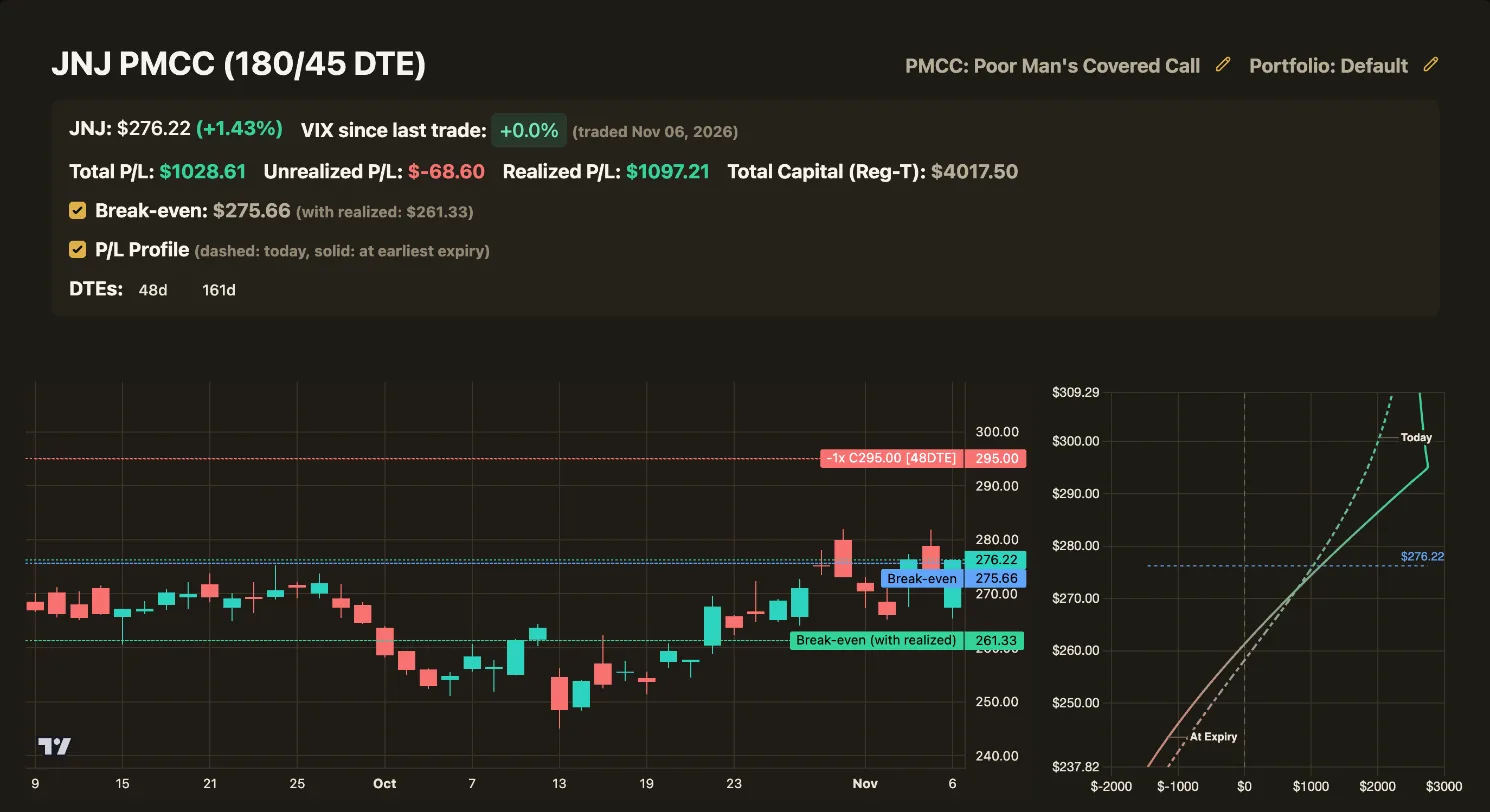
JNJ fell 1.4% on Thursday, about a third of SPY's drop. On Friday it dipped to $265.55, right at the short call's 265 strike, then rallied to close at $276.22.
Friday: 21 days
The short call reached 21 days to expiration on Friday. The rules roll it out to about 45 days, at 25 delta. The roll went to December 24, 48 days out. The Week 3 review had named December 18, which sat as far on the other side of 45.
The debit
The Week 3 review expected a debit of about $415, at Tuesday's price. JNJ was $9 higher at the fill, and the debit grew with it.
| Order | Price | Commission | Net |
|---|---|---|---|
| Buy 1 JNJ Nov 27 2026 265 call | $13.15 | $0.55 | $1,315.55 debit |
| Sell 1 JNJ Dec 24 2026 295 call | $3.05 | $0.55 | $304.45 credit |
Net debit: $1,011.10.
The 265 call was about $10.35 in the money, and buying it back cost $13.15. A call at about 25 delta, seven weeks out, brought in $3.05.
The long call rolls up
Under the rules, a short call rolled for a debit takes the long call with it. Two minutes later, the long call rolled up from the 220 strike to the 240, with the same April expiration.
| Order | Price | Commission | Net |
|---|---|---|---|
| Sell 1 JNJ Apr 16 2027 220 call | $60.35 | $0.67 | $6,034.33 credit |
| Buy 1 JNJ Apr 16 2027 240 call | $43.90 | $0.55 | $4,390.55 debit |
Net credit: $1,643.78.
The 220 call cost $39.45 in October, and its sale banked $2,088.55. The new 240 call sits at about 80 delta, so the pair is reset around JNJ's price. Together the two rolls took in $632.68.
Where JNJ stands
The best case and break-even are estimates from the P/L profile. All three figures count the $1,097.21 banked.
- Best case: about $2,750, with JNJ at $295 on December 24. The short call expires worthless there.
- Break-even: about $261 on December 24, 5.4% below Friday's close.
- Max loss: $2,988.89, with JNJ below $240 when the long call expires in April. It started at $3,621.57.
Max loss = open debit − realized = $4,086.10 − $1,097.21 = $2,988.89
The long call's own triggers are a long way off. It has 161 days left, and the rules roll it under 90. Its delta is 0.81, against a floor of 0.70.
IWM: tested, and held
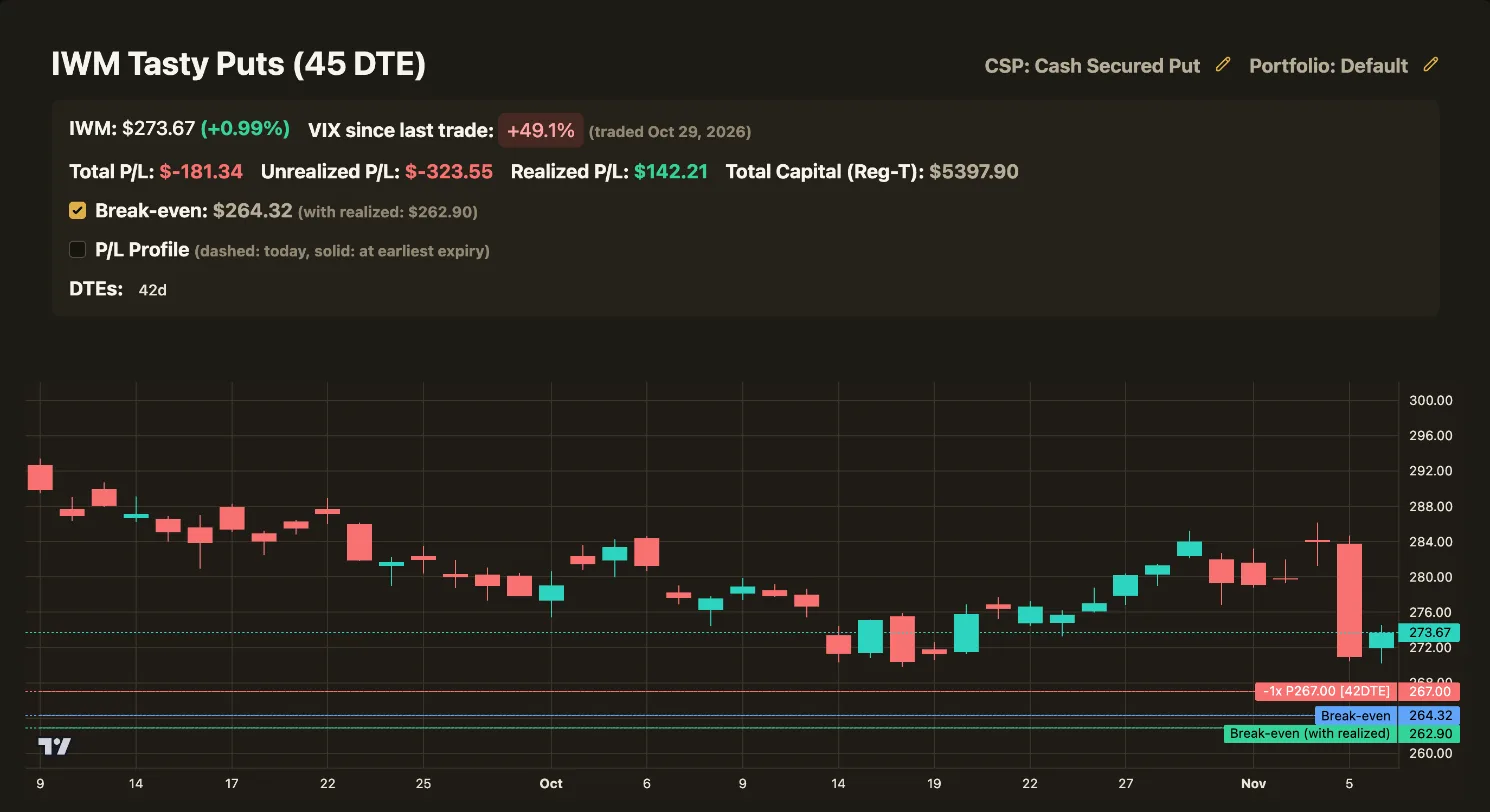
IWM fell 4.6% on Thursday. On both Thursday and Friday it traded within $4 of the 267 strike, and it closed Friday at $273.67.
The put is at $5.92, more than twice the $2.69 it sold for. It's $323.55 under water, and the campaign is $181.34 down after the first put's gain. Its delta rose to 0.36, so the position now moves like 36 shares of IWM.
The margin rose with it. At Friday's close the put tied up $5,397.90, up from $4,254.30 at the sale.
A put this close to its strike invites a quick exit. The rules have no stop-loss. They buy the put back below about $1.35, half its credit. Otherwise they close or roll it at 21 days, on November 27. Until one of those comes, the put stays open.
The plan
- Friday, November 13: UPRO. The 123 call rolls to next week's 70-delta call in the session's last 30 minutes, or sooner if its time value drops below $0.05. If the long call's delta leaves 77–82, the rules swap it for a new 80-delta call.
- JNJ. Once the short call trades below about $1.53, half its credit, the buy-back goes in during a session's last 30 minutes. Otherwise it rolls at 21 days, on Thursday, December 3.
- IWM. Below about $1.35, the buy-back goes in during a session's last 30 minutes. Otherwise the put reaches 21 days on Friday, November 27.
- Next week. The Week 4 review covers all three campaigns.