Blog /
UPRO rose 7% in a week, and its weekly pair lost $12
UPRO rose 7.4% in the week to Friday, November 13, and its weekly pair closed $12.25 down, capped by the in-the-money short call. Friday's roll moved both strikes up by 10. The three example campaigns still made $956.24, to $2,007.59. JNJ, at a one-year high, and the IWM put did that with no trade.
By Team Iron Wheel
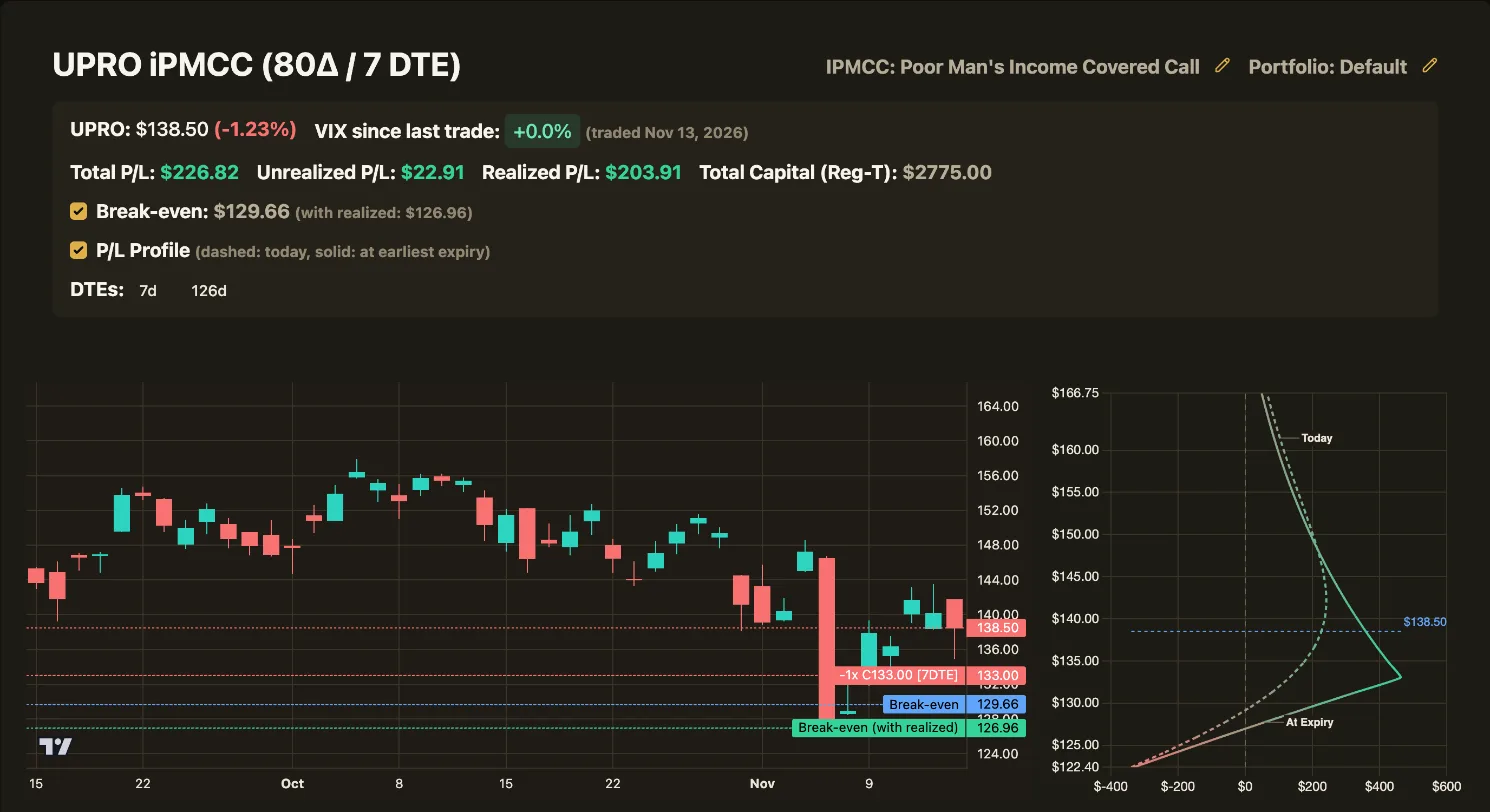
UPRO rose 7.4% over the week, and its weekly pair closed $12.25 down. The in-the-money short call took back what the long call made, and Friday's roll moved both strikes up by 10. The other two campaigns made the money. JNJ set a one-year high, and the IWM put recovered most of its open loss, with no trade in either. All three made $956.24 over the week. The figures are from The Iron Wheel at Friday's close, November 13. It is an example for education, not a recommendation.
| Campaign | P/L | Since November 6 | Friday | Next trigger |
|---|---|---|---|---|
| UPRO iPMCC | +$226.82 | +$22.74 | Rolled, long call moved up | Weekly expiration on November 20 |
| JNJ PMCC | +$1,701.11 | +$672.50 | Held | 21 days to expiration on December 3 |
| IWM puts | +$79.66 | +$261.00 | Held | 21 days to expiration on November 27 |
| All three | +$2,007.59 | +$956.24 |
The market: a calm week
After the drop on November 5, the week was calm and mostly green. Monday's bounce did most of the work, as the Week 4 review showed.
| Friday, November 13 | Close | Week |
|---|---|---|
| SPY | $754.37 | +2.6% |
| QQQ | $679.89 | +3.6% |
| IWM | $277.54 | +1.4% |
| UPRO | $138.50 | +7.4% |
| JNJ | $285.75 | +3.5% |
| VIX | 19.30 | −24.7% |
Friday dipped, and QQQ fell 1.2%. CNN's Fear & Greed index for stocks rose from 22 to 39 over the week, still in fear.
Since the Week 4 review on Tuesday, the campaigns added $285.24.
UPRO: the short call capped the week
UPRO rose 6.5% from one roll to the next, to about $138. The pair closed $12.25 down over the same week.
- The short 123 call: sold for $9.50, bought back for $15.11, a loss of $562.09.
- The long 100 call: bought for $36.91, sold for $42.43, a gain of $549.84.
- 100 shares of UPRO would have made about $840 over the same move.
The short call's time value decayed as planned, from about $2.90 to 12 cents. UPRO's rise of about $8.40 added the same to its in-the-money value, though. The long call made back $5.52 a share of it.
A short call this deep works both ways. Last week it absorbed a drop, and this week it capped the bounce.
The roll
Friday's schedule kept the roll out of the session's last 30 minutes, so it went in at 3:16 pm ET. The expiring 123 call had about 12 cents of time value left, above the $0.05 that brings the roll forward on its own.
| Order | Price | Commission | Net |
|---|---|---|---|
| Buy 1 UPRO Nov 13 2026 123 call | $15.11 | $1.04 | $1,512.04 debit |
| Sell 1 UPRO Nov 20 2026 133 call | $6.90 | $1.05 | $688.95 credit |
Net debit: $823.09.
The strike moved up with UPRO, from 123 to 133. The new call is 7 days out at about 0.70 delta, by a Black-Scholes estimate. With UPRO at about $138, it was about $5 in the money. The other $1.90 of its price is time value, the part next week is meant to earn.
The long call moves up
A minute later, the long call moved up to the 110 strike.
| Order | Price | Commission | Net |
|---|---|---|---|
| Sell 1 UPRO Mar 19 2027 100 call | $42.43 | $1.13 | $4,241.87 credit |
| Buy 1 UPRO Mar 19 2027 110 call | $34.40 | $1.04 | $3,441.04 debit |
Net credit: $800.83.
The 100 call had sat above its 77–82 delta band since Monday's bounce. The rules swap it for a new 80-delta call, and the higher strike costs less. Together, the roll and the re-centre cost $22.26.
Where UPRO stands
The best case and break-evens come from the app's P/L profile, which prices the long call at Friday's implied volatility, so they're estimates. All three figures count the $203.91 already banked.
- Best case next week: about $465, with UPRO at $133 on November 20. The short call expires worthless there, and the long call keeps its time value.
- Break-even: about $127 and about $176 on November 20. Between the two, the campaign is in the black. The lower one sits 8.3% below Friday's close.
- Max loss: $2,548.18, with UPRO below $110 when the long call expires in March. It leaves out the weekly rolls still to come.
Max loss = open debit − realized = $2,752.09 − $203.91 = $2,548.18
JNJ: a new high, near the strike
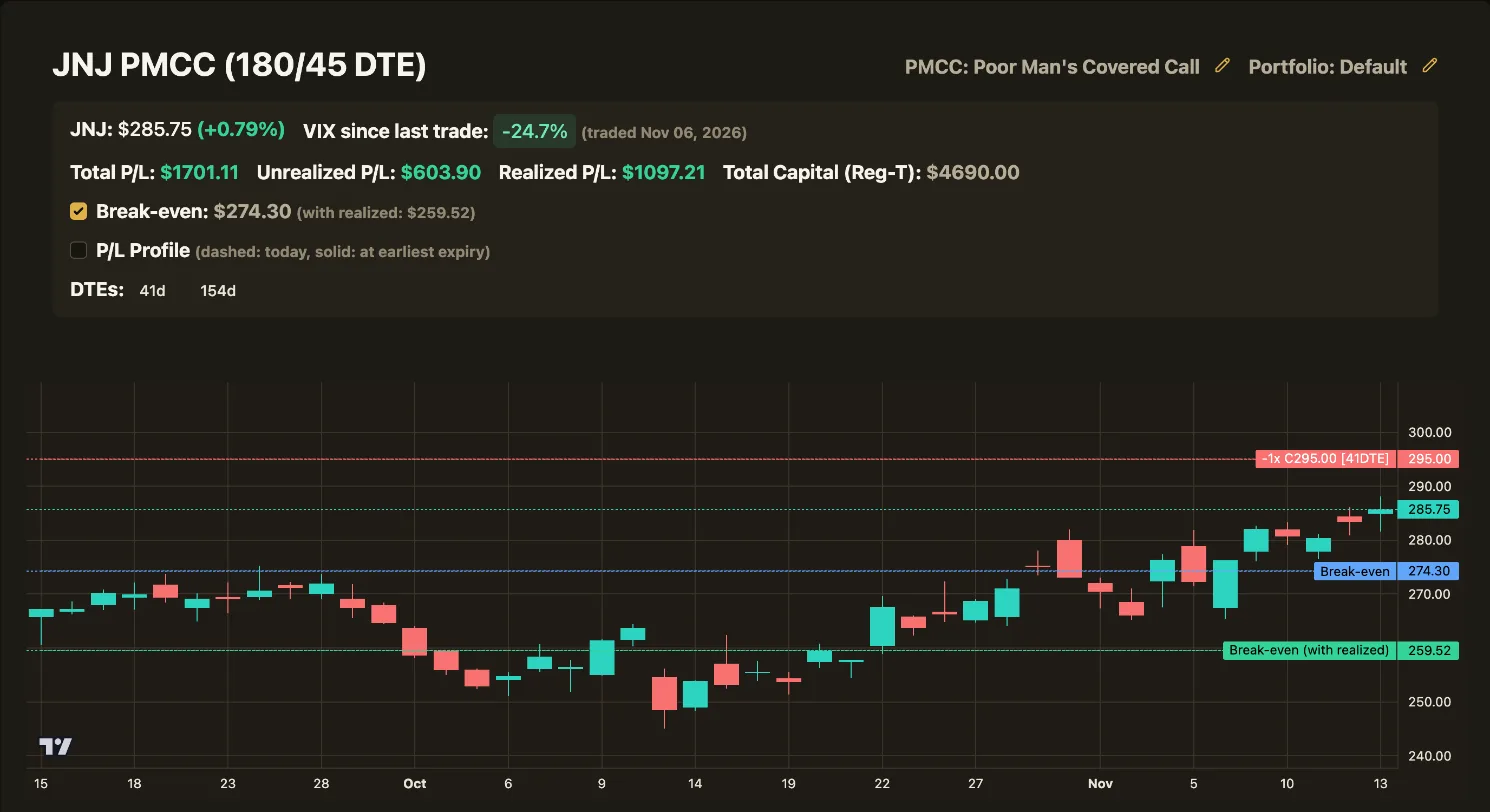
JNJ rose 3.5% over the week. On Friday it touched $288.11, a new one-year high, and closed at $285.75, its best close of the year.
The campaign made $672.50 with no trade. The long call gained $853.00, and the short call lost $180.50.
JNJ now sits 3.2% below the 295 strike. With JNJ right at the strike on December 24, the campaign would be up about $2,830, by the P/L profile's estimate.
The rules hold
The short call is $238.05 under water, and it climbs with every step JNJ takes toward the strike. The rules don't act on that.
- The short call is at $5.43, far from the buy-back at about $1.53. It reaches 21 days on Thursday, December 3.
- The long call sits at 0.85 delta, above the 0.70 floor. It has 154 days left, and the rules roll it under 90.
IWM: still holding
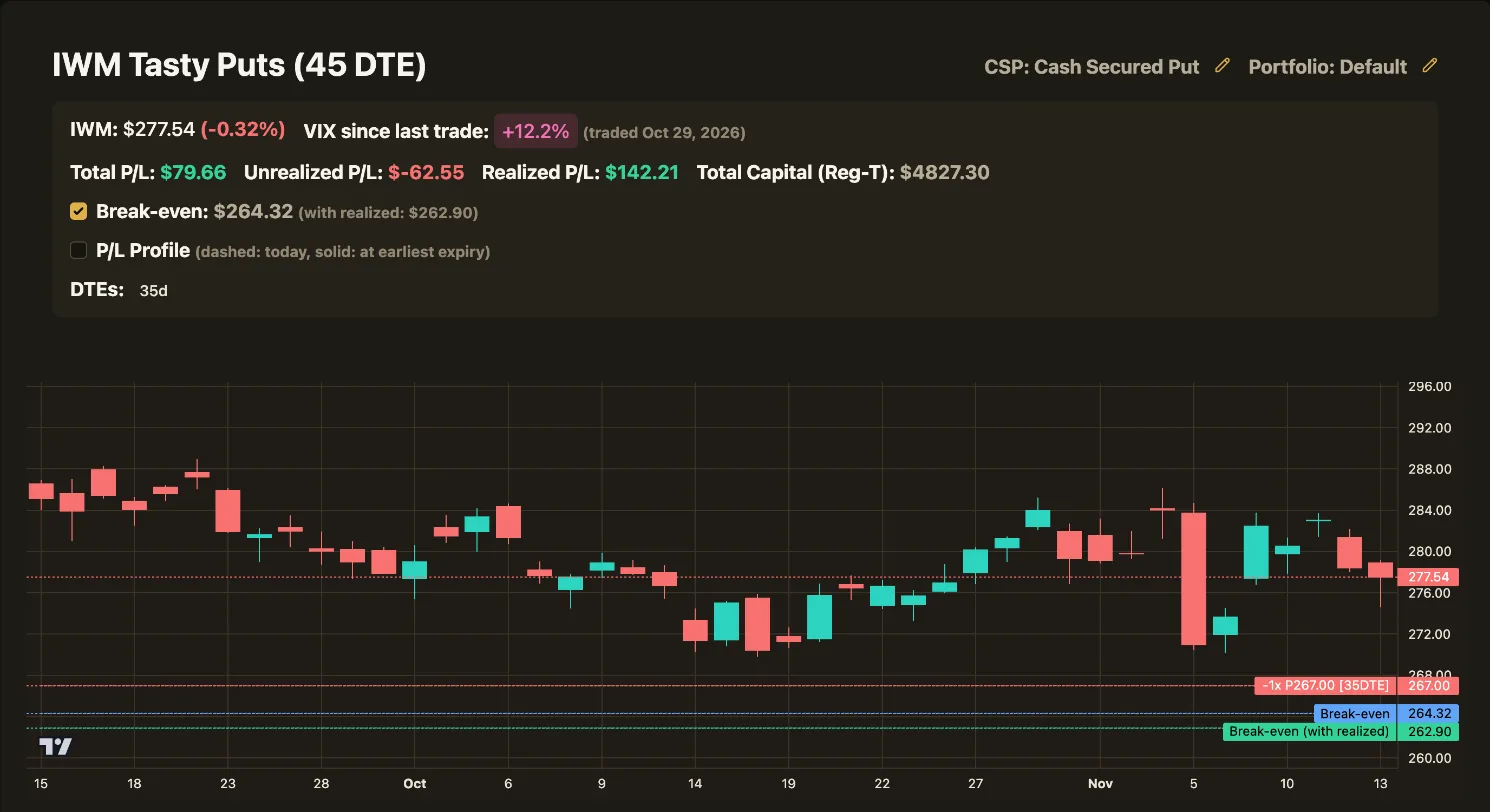
IWM rose 1.4% over the week, but it gave back more than half of Monday's bounce by Friday.
The put is at $3.31, down from $5.92 a week ago. The campaign made $261.00 over the week, and it's $79.66 up.
The put is still $62.55 under water, at 0.27 delta. It ties up $4,827.30 of capital, down from $5,397.90 a week ago.
The rules have no stop-loss. They buy the put back below about $1.35, half its credit. Otherwise they close or roll it at 21 days, on Friday, November 27. The put stays open.
The plan
- Friday, November 20: UPRO. The 133 call rolls to next week's 70-delta call in the session's last 30 minutes, or sooner if its time value drops below $0.05. If the long call's delta leaves 77–82, the rules swap it for a new 80-delta call.
- JNJ. Once the short call trades below about $1.53, the buy-back goes in during a session's last 30 minutes. Otherwise it rolls at 21 days, on Thursday, December 3.
- IWM. Below about $1.35, the buy-back goes in during a session's last 30 minutes. Otherwise the put reaches 21 days on Friday, November 27, the day after Thanksgiving. The market closes at 1 pm ET that day, so the last 30 minutes start at 12:30.
- Next week. The Week 5 review covers all three campaigns.